The Qurbono
Origins in Antioch
Syriac and Aramaic prayers
Fully chanted liturgy
Communion by intinction
Incense and sacred symbolism
Continuity with Antioch, Lebanon, and Rome
QURBONO
The Qurbono
The Divine Liturgy of the Maronite Church, known as the Qurbono, stands at the heart of Maronite spiritual and communal life.
The word “Qurbono” derives from a Syriac term meaning “offering” or “sacred sacrifice,” reflecting the Eucharistic offering at the center of Christian worship.
Rooted in the ancient Church of Antioch, the Qurbono preserves one of the oldest continuously living liturgical traditions in Christianity. The Maronite liturgy combines scripture, sacred chant, incense, symbolism, communal prayer, and sacramental worship in a deeply reverent and contemplative spiritual experience.
Unlike many modern liturgical traditions, the Qurbono retains a strong sense of sacred mystery, ritual continuity, and historical depth that connects worshippers to centuries of uninterrupted Christian prayer and worship.
At St. Elias Maronite Catholic Church, the Qurbono remains the spiritual center of parish life and a living expression of the Syriac-Antiochian heritage of the Maronite Church.
The word “Qurbono” derives from a Syriac term meaning “offering” or “sacred sacrifice,” reflecting the Eucharistic offering at the center of Christian worship.
Rooted in the ancient Church of Antioch, the Qurbono preserves one of the oldest continuously living liturgical traditions in Christianity. The Maronite liturgy combines scripture, sacred chant, incense, symbolism, communal prayer, and sacramental worship in a deeply reverent and contemplative spiritual experience.
Unlike many modern liturgical traditions, the Qurbono retains a strong sense of sacred mystery, ritual continuity, and historical depth that connects worshippers to centuries of uninterrupted Christian prayer and worship.
At St. Elias Maronite Catholic Church, the Qurbono remains the spiritual center of parish life and a living expression of the Syriac-Antiochian heritage of the Maronite Church.


Antioch
Origins in Antioch
The Maronite liturgical tradition traces its roots to Antioch, one of the earliest and most important centers of Christianity. Antioch holds special significance in Christian history as the place where followers of Jesus were first called Christians.
The Church of Antioch developed a rich liturgical and theological tradition centered upon:
The Church of Antioch developed a rich liturgical and theological tradition centered upon:
- Scripture
- Sacred poetry
- Chant
- Symbolism
- Communal worship
- Monastic spirituality
The Maronite Church emerged from this Antiochian Christian heritage and continues to preserve many of its ancient prayers, liturgical structures, and spiritual traditions to this day.
Through the Qurbono, Maronite Catholics remain spiritually connected to the early Christian communities of Antioch and the broader Syriac Christian tradition that flourished throughout the Middle East for centuries.
Through the Qurbono, Maronite Catholics remain spiritually connected to the early Christian communities of Antioch and the broader Syriac Christian tradition that flourished throughout the Middle East for centuries.
Prayers
Syriac and Aramaic Prayers
One of the most distinctive features of the Maronite Qurbono is the preservation of Syriac within the liturgy. Syriac is a dialect of Aramaic — the language spoken by Jesus Christ and the early Christian communities of the Near East.
The continued use of Syriac prayers and responses within the Qurbono creates a direct spiritual and historical link to the earliest centuries of Christianity. Ancient Syriac hymns, scriptural passages, and liturgical prayers continue to be chanted during major liturgical celebrations, feast days, Holy Week services, and sacramental rites.
At St. Elias Parish, the integration of Syriac alongside Arabic and English reflects both preservation of sacred heritage and accessibility for future generations growing within Canadian society.
The use of Syriac within the liturgy serves not only as a linguistic tradition, but also as:
The continued use of Syriac prayers and responses within the Qurbono creates a direct spiritual and historical link to the earliest centuries of Christianity. Ancient Syriac hymns, scriptural passages, and liturgical prayers continue to be chanted during major liturgical celebrations, feast days, Holy Week services, and sacramental rites.
At St. Elias Parish, the integration of Syriac alongside Arabic and English reflects both preservation of sacred heritage and accessibility for future generations growing within Canadian society.
The use of Syriac within the liturgy serves not only as a linguistic tradition, but also as:
- A symbol of continuity
- Preservation of identity
- Connection to the early Church
- Expression of sacred reverence and historical memory

Liturgy
Fully Chanted Liturgy
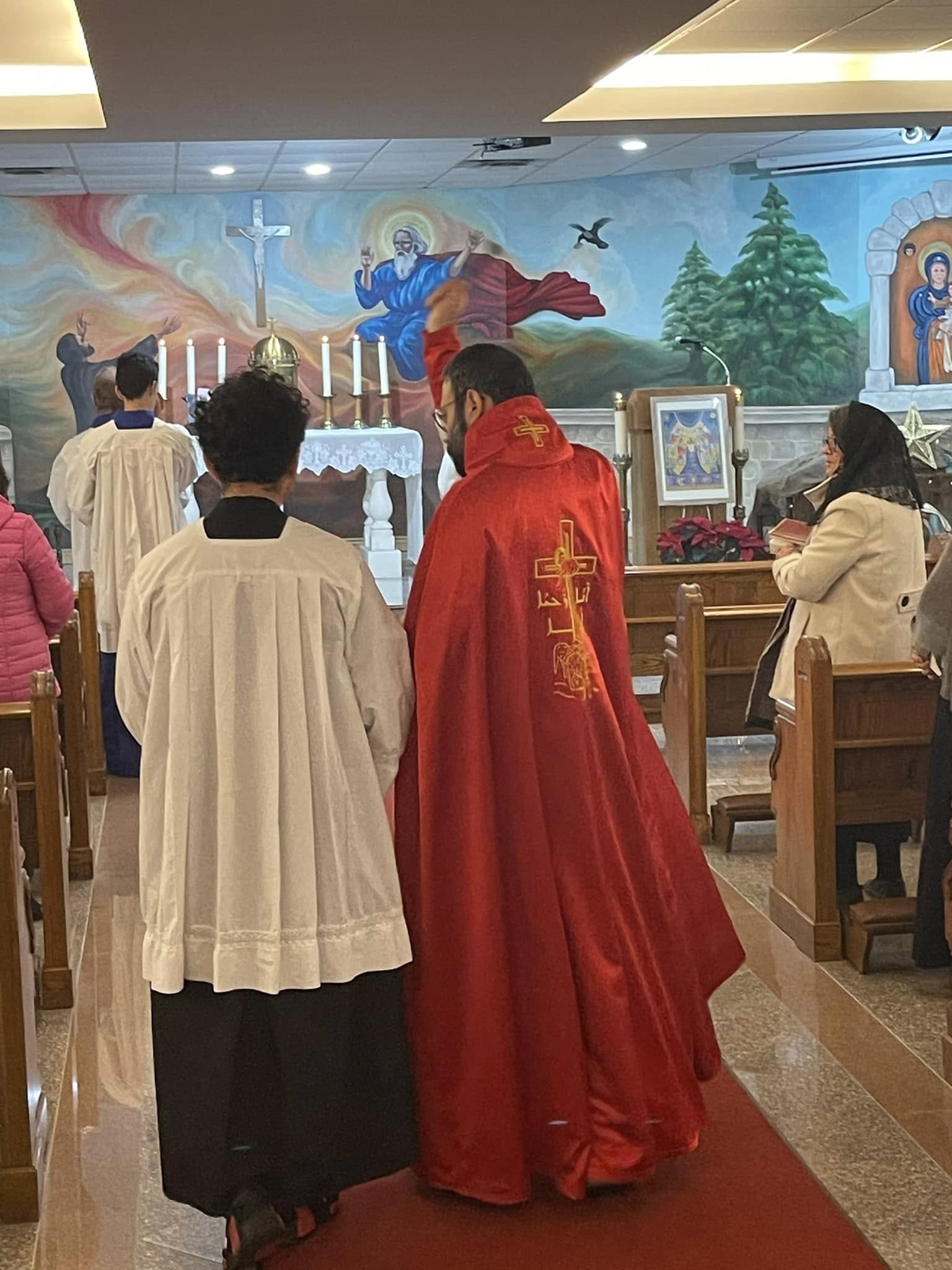
The Maronite Qurbono is distinguished by its extensive use of sacred chant throughout nearly every aspect of worship. Rather than viewing chant as decorative music, the Maronite tradition understands chanting itself as prayer.
The liturgy incorporates:
The liturgy incorporates:
- Scriptural chant
- Communal sung responses
- Priestly intonations
- Syriac hymns
- Penitential melodies
- Feast day chants
- Solemn Holy Week lamentations
This fully chanted form of worship creates a deeply contemplative and spiritually immersive atmosphere that emphasizes reverence, participation, beauty, and sacred mystery.
The interaction between priest, choir, and congregation through chant reflects the communal nature of worship within the Maronite tradition and reinforces the sense of continuity with centuries of Syriac Christian liturgical life.
The interaction between priest, choir, and congregation through chant reflects the communal nature of worship within the Maronite tradition and reinforces the sense of continuity with centuries of Syriac Christian liturgical life.
Intinction
Communion by Intinction
Within the Maronite tradition, Holy Communion is typically distributed by intinction, where the consecrated Body of Christ is dipped into the Precious Blood before being received by the faithful.
This practice reflects:
- Reverence for the Eucharist
- Liturgical continuity with Eastern Christian tradition
- The unity of the Body and Blood of Christ
- The sacredness of sacramental worship
Communion within the Qurbono is approached with solemnity, prayer, fasting, preparation, and spiritual reflection. The Eucharist remains the central sacramental encounter within the spiritual life of the Church and the source of unity within the parish community.


Symbolism
Incense and Sacred Symbolism
The Maronite liturgy is deeply symbolic and engages the senses through incense, candlelight, sacred vestments, ritual movement, chant, and visual symbolism. Every aspect of the Qurbono is intended to draw the faithful into deeper prayer and contemplation of divine mystery.
Incense occupies a particularly important role within the liturgy and accompanies:
Incense occupies a particularly important role within the liturgy and accompanies:
- Gospel processions
- The consecration of the Eucharist
- Feast day celebrations
- Funerals and memorials
- Holy Week liturgies
- Blessings and processions
The rising incense symbolizes the prayers of the faithful ascending toward God while also creating the solemn and sacred atmosphere that distinguishes Maronite worship.
Other important liturgical symbols include:
Other important liturgical symbols include:
- Light overcoming darkness
- The Cross
- Sacred chant
- Liturgical colors
- Processions
- Fasting and penitence
- Communal responses
Together, these elements create a worship experience that is both spiritually profound and historically rooted in the Syriac Christian tradition.
Continuity
Continuity with Antioch, Lebanon, and Rome
The Maronite Church occupies a unique place within global Christianity by preserving its ancient Antiochian and Syriac heritage while remaining continuously in full communion with the Roman Catholic Church.
This continuity reflects:
This continuity reflects:
- Fidelity to the early Christian tradition
- Preservation of Eastern liturgical identity
- Spiritual connection to Lebanon and the Middle East
- Unity with the universal Catholic Church
The Maronite Church carried its faith, liturgy, language, spirituality, and communal identity through centuries of migration, persecution, political upheaval, and diaspora while preserving continuity across generations.
At St. Elias Parish, this continuity remains alive through:
At St. Elias Parish, this continuity remains alive through:
- Bilingual liturgies
- Syriac prayer and chant
- Feast day celebrations
- Family participation
- Devotion to the saints
- Preservation of cultural and spiritual heritage
- Communion with the wider Catholic Church
The Qurbono, therefore, serves not only as worship, but also as a living expression of faith, identity, history, continuity, and spiritual belonging for Maronite Catholics throughout the world.
